
For years, winning Google Search was simple.
- Create a better page,
- Earn backlinks,
- Satisfy search intent,
- And hope your content reaches the first page.
That approach still matters, but it isn’t the whole story anymore. Today,
Millions of People Get Answers Directly from AI Overviews
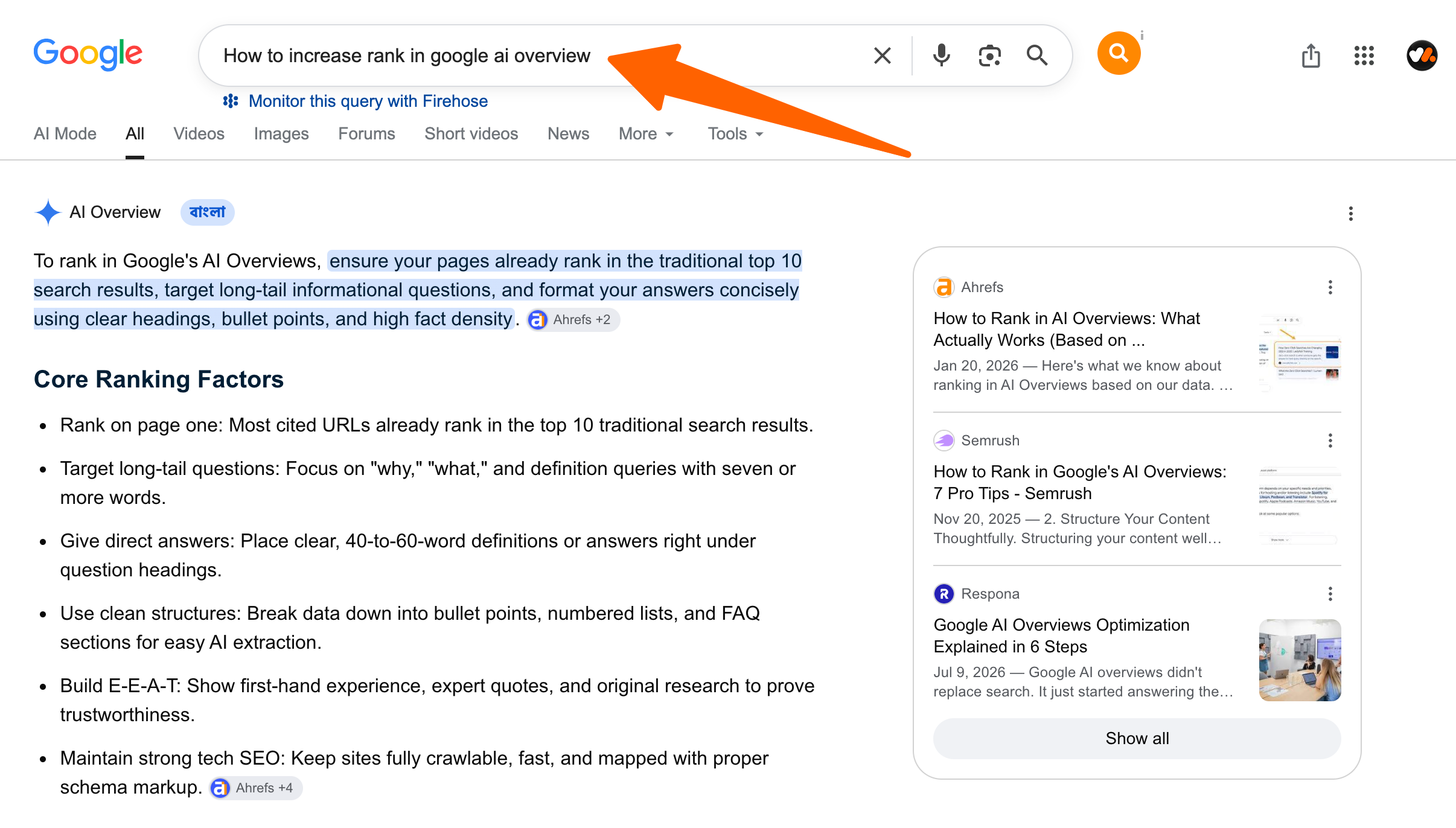
Instead of clicking through ten blue links, they prefer AI overview answers.
According to Brand Radar of Ahref statistics, Nowadays, 108 million people use AI Overview queries worldwide
If your website isn’t one of the sources Google references, you can publish the best article on the internet and still be invisible.
Google knows how people discover websites is already changed. That’s why it introduced Preferred Sources.
It is a feature that gives users more control over which websites they want to see across Google Search and now, inside AI Overviews and AI Mode.
The Statistics Show Why This Matters

People are twice as likely to click through to a Preferred Source.
Google also revealed another interesting statistic:
People have already selected more than 345,000 unique sources.
Now question yourself: is your domain in these 345,000 sources?! Maybe strongly no.
Think about what that means.
Google is no longer relying only on algorithms to decide which sources people see. Users can now tell Google,
I trust this website. Show it to me whenever it’s relevant.
That changes the reality. Instead of competing only for rankings, websites now have an opportunity to compete for trust. And if you are not in their bookmarks your are invisible day by day.
And in an AI-first search experience, trust is becoming one of the most valuable assets a publisher can build.
In this guide, you’ll learn what Google Preferred Source is, why it matters for AI Overview citations, and how to position your website so readers are more likely to choose it as a trusted source in 2026.
So let’s get started,
TL;DR – Google Preferred Sources
Quick Answer: Google preferred source is a new opportunity to increase AI Overview citations by helping Google understand that users consistently trust and prefer your website.
Building trust so that people choose as a preferred source can improve your visibility, credibility, and chances of being cited in AI-generated search experiences.

What is Google Preferred Sources
Google Preferred Sources is a Google Search feature that lets users choose the websites they trust and want to see more often in Search, AI Overviews, and AI Mode.
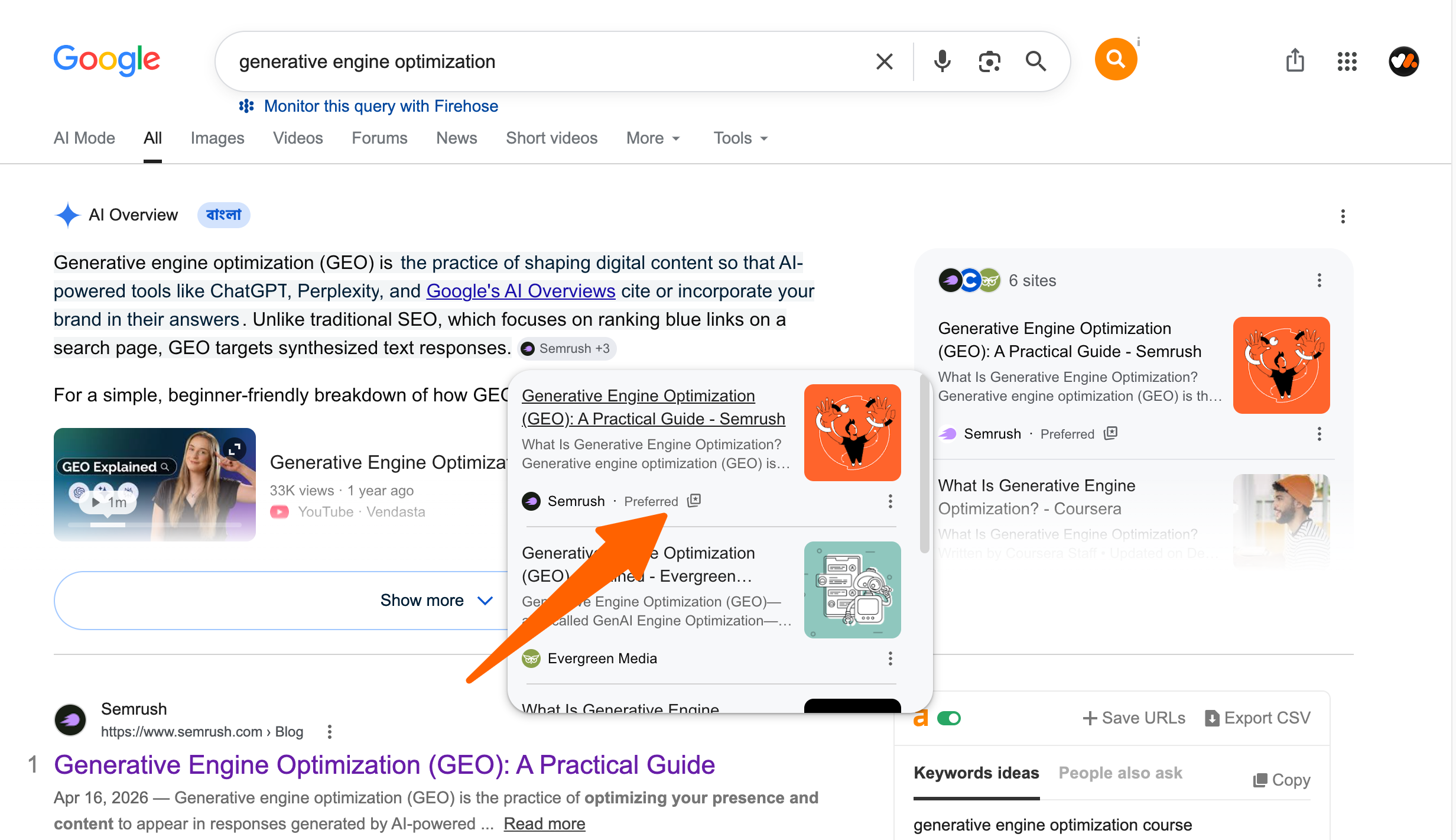
Now, I have searched for Generative engine optimization, and as I selected SEMrush as my preferred source, it is showing when I search for anything related to the SEMrush blog in the AI search engine.
Another simple example, your favorite coffee shop is Starbucks. Even if another café is closer, you keep going back because you trust the quality and service. Over time, you become a loyal customer.
Google Preferred Sources works similarly. When users choose your website as a trusted source, they’re telling Google, “This is a site I want to see again.”
That loyalty doesn’t guarantee AI Overview citations, but it can increase your website’s AI search visibility and strengthen the trust signals Google uses across its AI-powered search experiences.
Why Google Preferred Sources Matter for AI Overview Citations

Most website owners believe getting cited in AI Overviews is all about publishing more content and tracking brand mentions. But It’s not.
Google’s AI doesn’t just look for pages that mention a topic. It looks for sources it can trust to provide helpful, reliable information.
That’s why many smaller websites with excellent content still struggle to appear in AI-generated answers. Google Preferred Source adds another layer to that trust.
When someone marks your website as a Preferred Source, they’re sending Google a strong signal that your content is worth returning to.
Google has already confirmed that people are “twice as likely to click through to a Preferred Source.” That tells us Preferred Sources influence how users interact with search results, even if they aren’t a direct ranking signal.
Why that matters for AI citations.
AI Overviews are designed to answer questions while linking people to useful sources for additional information. If users consistently
- Prefer your website,
- Engage with your content,
- And return to it,
Google receives evidence that your site provides value beyond a single search.
Think of it this way.
Traditional SEO was about convincing Google’s algorithm that your page deserved to rank. The AI era is increasingly about convincing both Google and real people that your website is the source they trust.
That’s a major change.
- Instead of asking, “How do I rank #1?”,
- Publishers should be asking, “Why would someone choose my website over every other source?”
The websites that answer that question consistently are more likely to earn repeat visitors, stronger brand recognition, and greater visibility across Google’s AI-powered experiences.
Google Preferred Source doesn’t magically guarantee GEO citations. But it aligns with the direction Google Search is going nowadays: rewarding trusted, people-first content that users actively choose to read.
In other words, if you want more AI citations in 2026, don’t just optimize for algorithms. Optimize to become the source people prefer.
How to Add Google Preferred Source Badge to Your Website

If you’ve built an audience that trusts your content, don’t wait for readers to discover the Preferred Sources feature on their own.
Google encourages publishers to make it easy for visitors to add their website as a preferred source by placing a badge or button on their site. Here’s how to do it.
1. Get the Official Badge

Google provides official resources that publishers can use to encourage readers to add their site as a Preferred Source. These include a branded badge, setup instructions, and best practices.
- Download Google Badge Image Button – Add Google as a Preferred Source
- Then unzip the file what you downloaded
- You will get a folder; open it
- Then you will get 4 images (black-and-white badge) of Google Preferred badges like above
2. Link the Badge to Your Preferred Source Page

Once you have the badge image, the next step is to link it to your Google Preferred Source page. Now I am telling you step by step how you can do so:
- Copy this deep link: https://google.com/preferences/source?q=
- and just add your domain name after = sign.
For example, I have added whatisguide.com after = sign, and my link becomes:
https://google.com/preferences/source?q=whatisguide.com
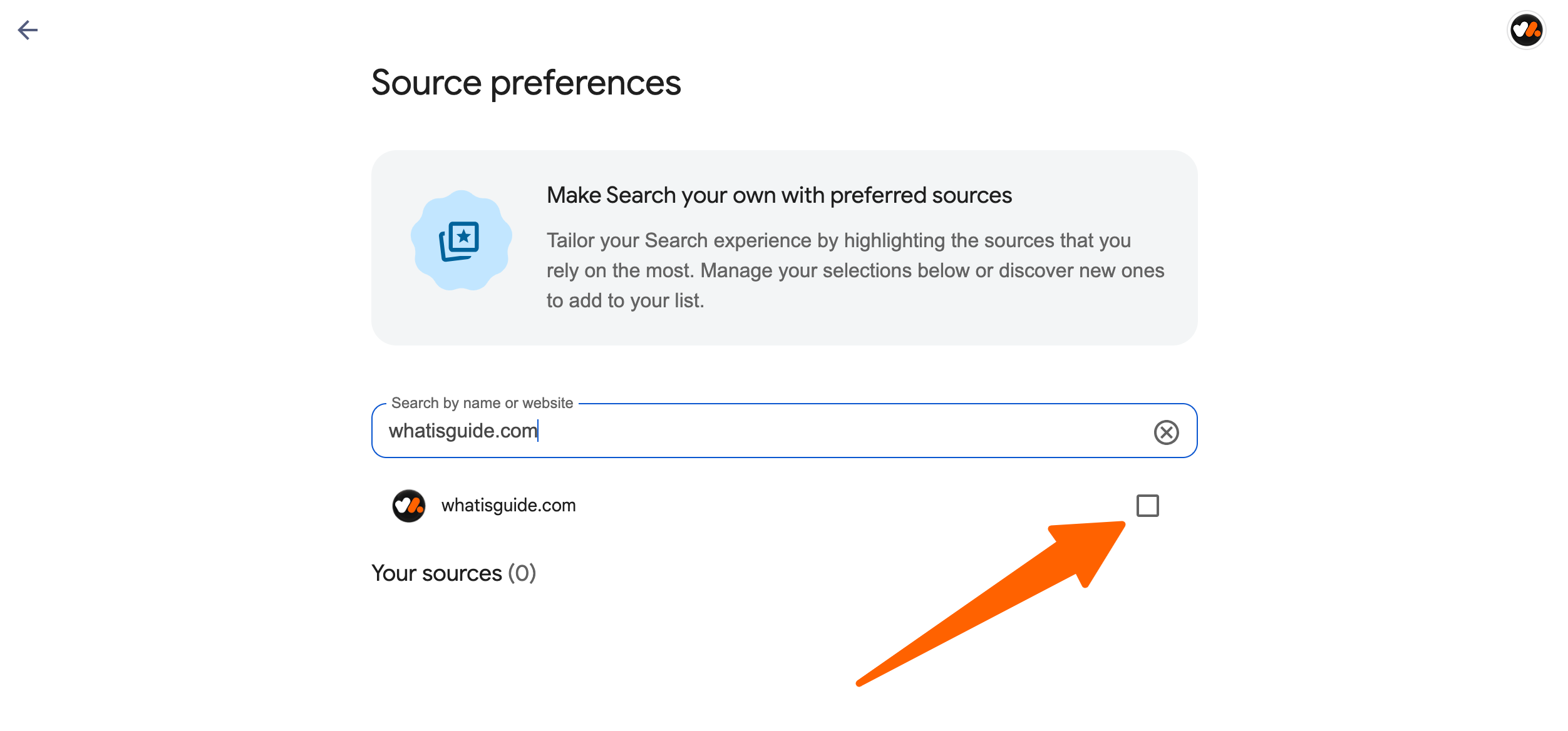
Now, when visitors click my link, they’ll be taken directly to my website’s Google Preferred Source page and then they checkbox to set my website as their preference.
And if it is your domain name after “= sign”, your visitor will go to your website’s Google Preferred Source page. That means they don’t have to search for your domain name because of the link you created. Try it Now.
- All your customer need to do is click the link & check the box next to your domain, and save their preference.
From then on, Google knows they prefer your website when it’s relevant to their searches.
This deep link removes extra steps, making it much easier for loyal readers to add your website as a Preferred Source. The easier the process, the more likely people are to do it.
3. Place It Where People Will Notice It

Don’t hide the badge in your footer.
Instead, add it to places where loyal readers are most likely to see it, such as:
- Below your articles
- In your website sidebar
- On your About page
- Inside your email newsletter
- On your thank-you or confirmation pages
People who already trust your content are the most likely to add your site as a Preferred Source.
4. Explain Why It Matters

A badge alone isn’t always enough.
Add a short message like:
Enjoy our content? Add us as your Google Preferred Source to see more of our articles in AI Overviews, AI Mode, and Top Stories.
This helps visitors understand the benefit before they click.
5. Keep Publishing High-Quality Content

Adding the badge is only the first step. People will only choose your website if you consistently provide useful, accurate, up-to-date, and structured content.
Think of the badge as an invitation – not a shortcut. The real goal is to earn your readers’ trust so they want to keep seeing your high-quality content whenever they search.
Tip: If you use WordPress, there’s also a community plugin called “Add as Preferred Source on Google” that can display a customizable banner or button on your site. It’s not an official Google plugin, but it can simplify implementation
More Ways to Increase AI Overview Citations as a Google Preferred Source

There’s a common belief that AI citations are impossible to influence. If Google chooses the sources, what can you actually do? Quite a lot.
While you can’t ask Google to cite your website, you can create the kind of experience that makes people trust your content enough to choose it as a Preferred Source.
That’s the belief behind this strategy: AI citations are earned through trust, not tricks. Here are the steps that matter most.
1. Become the Best Answer, Not Just Another Answer

AI Overviews are built to summarize the web. If your content repeats what everyone else is saying, there’s little reason for Google to reference it.
Instead, publish original insights, real examples, screenshots, case studies, first-hand experience, and data that readers can’t find elsewhere.
Ask yourself:
If someone removed my brand name, would this article still stand out?
If the answer is no, improve it before publishing.
2. Build a Brand People Remember

Google Preferred Source is based on user choice. People won’t choose a website they’ve never heard of.
Create a recognizable brand by publishing consistently, using the same writing style, and becoming known for a specific topic.
When readers search for answers and repeatedly find value on your site, they’re more likely to mark it as a Preferred Source.
Trust is built over dozens of helpful interactions, not one viral article.
3. Write for Humans Before AI

Many publishers are writing for AI models instead of real people. That’s backwards. Google has repeatedly emphasized creating helpful, reliable, people-first content.
Articles that answer real questions clearly are more likely to satisfy readers, and satisfied readers are more likely to trust your website.
So now, although you write an article with AI, you need to make it humanized to stand out from others.
And your article should be complete in one place or within your website’s internal links. If a visitor finishes your article without needing another search, you’ve done your job.
4. Earn Repeat Visitors

- One visit is useful.
- Ten visits build trust.
Publish related content that naturally leads readers to another helpful guide. Build topical authority around a niche instead of jumping between unrelated subjects.
Reach out to those people through email marketing so that they can return to your website.
You can also get emails from LinkedIn for free to reach out to those people who is your real customers, not for a sales pitch but for helpful content that solves your customers’ problems.
The more often people return to your website, the stronger your brand becomes.
5. Make Your Content Easy to Verify

AI systems prefer information they can understand and verify.
Include clear headings, cite authoritative sources like Google Search Central, Google Search Console, and official documentation, and update articles when information changes.
For example, if you see UberSuggest content, Nail Patel always give reference of SEMRush and Ahrefs, although they are his competitors.
He chose based on authority and the reader’s perspective so that his customers can find good information to build trust in his website.
When your content is transparent and well-supported, it becomes easier for both users and AI systems to trust.
6. Give People a Reason to Choose You

Most websites explain what happened. The websites that earn citations explain why it matters.
Share your own testing, lessons learned, comparisons, workflows, or unique perspectives. These are the details that separate your content from hundreds of similar articles.
Remember, Google can summarize facts. It can’t replace genuine experience.
7. Think Beyond Rankings

The biggest mindset change for 2026 is this: Don’t measure success only by where your page ranks. Measure whether people
- Remember your website,
- Return to it,
- Recommend it,
- And choose it as a trusted source.
That’s the kind of reputation Google is increasingly rewarding across AI-powered search experiences.
Conclusion
Google Preferred Source shows that trust matters more than ever. Google wants to show content from websites that people choose and come back to.
If you want more AI Overview citations, don’t look for quick tricks. Focus on creating helpful, original content that answers real questions better than anyone else.
The more people trust your website, the more likely they are to choose it as a Preferred Source. That trust can help your brand grow in Google’s AI search experience.
Keep improving your content, update it regularly, and put readers first. In the long run, trust is what helps you earn more AI citations, not just higher rankings.
** FAQ **
01. What is the difference between Google Preferred Source and AI Overview citations?
Google Preferred Source lets users choose websites they trust, while AI Overview citations are the sources Google selects to support AI-generated answers. Being a Preferred Source doesn’t guarantee citations, but it can help build trust and visibility.
02. Why isn’t my website getting cited in AI Overviews?
The most common reasons are a lack of original content, weak topical authority, outdated information, or content that doesn’t fully answer the user’s question. Improving quality and demonstrating expertise can increase your chances.
03. How can I encourage visitors to choose my website as a Preferred Source?
The best way is to consistently publish accurate, helpful, and easy-to-understand content. When readers repeatedly find value on your site, they’re more likely to trust your brand and choose it as a Preferred Source.
04. When should I update my content to improve AI citations?
Update important articles whenever Google changes its documentation, new research becomes available, or your information becomes outdated. Fresh, accurate content is more valuable to both readers and AI systems.
05. Which websites are most likely to earn AI Overview citations?
Websites that publish original insights, real-world experience, expert guidance, and trustworthy information are more likely to be cited. Building a strong reputation over time gives Google more confidence in your content.