
You may already rank on Google’s first page for important SaaS-related keywords, but that does not automatically mean ChatGPT, Perplexity, or Google AI Overviews will mention your software.
That is because traditional SEO and AI search do not work the same way.
Google can show your page as a search result, while an AI search engine may retrieve information from several sources, understand the information, and use only selected parts of those sources to create an answer.
This is where RAG (Retrieval-Augmented Generation) becomes important for Generative Engine Optimization (GEO).
If you understand how AI systems retrieve information, you can structure your SaaS website, product pages, documentation, comparison content, and other online references so they are easier for AI systems to understand and potentially cite.
So let’s get started,
What is RAG for SaaS Businesses in GEO

RAG (Retrieval-Augmented Generation) is a process where an AI system retrieves relevant information from available sources and uses that information as context when generating an answer. In simple terms:
Search → Find relevant information → Read the information → Generate an answer
For example, someone asks: “What are the best project management tools for remote SaaS teams?” An AI search system may look for relevant information across the web. It could find your product pages, software comparison articles, review websites, documentation, and other sources.
It then uses relevant information from those sources to help generate the answer and may show you citations to some of them in the AI overview, ChatGPT, Claude, etc.
How GEO Helps in the RAG Process
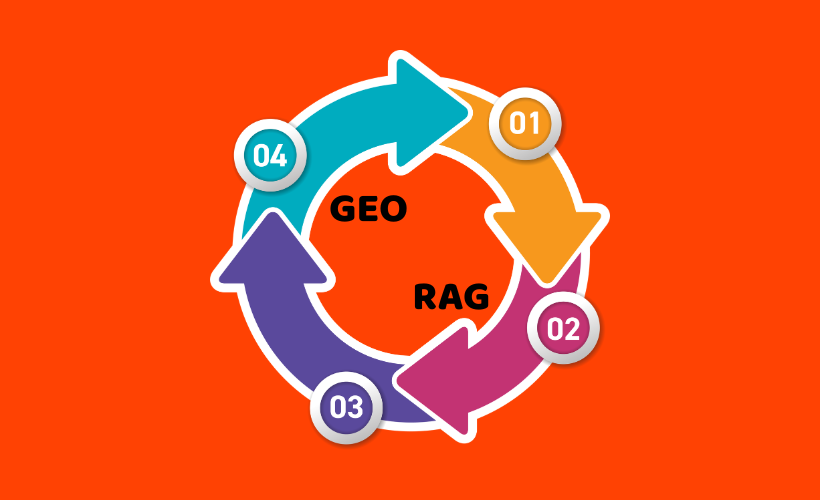
GEO (Generative Engine Optimization) is the process of improving your content and online presence so AI search systems can better understand your brand, products, expertise, and answers to relevant questions.
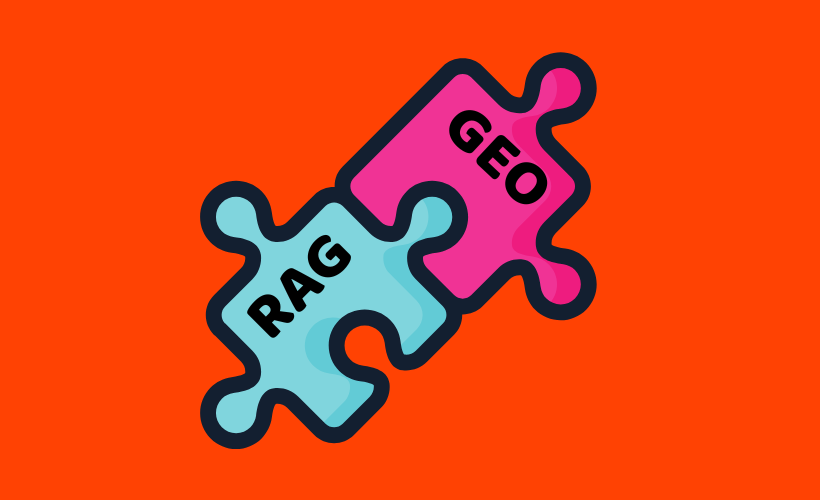
For example, RAG is part of the retrieval process. GEO is what you do to make your information easier to retrieve, understand, and use.
For a SaaS company, that means your GEO work should not stop at getting a page to rank for a keyword. You also want AI systems to clearly understand:
- What your software does
- Who it is designed for
- Which problems it solves
- What features it provides
- How it compares with alternatives
- How much it costs
- Which use cases it supports
- Why customers or independent sources mention it
A Simple Example of WordPress Plugins

Suppose you sell a WordPress analytics plugin. You publish a page called: “Analytics Software for WordPress Agencies”
Instead of only repeating the keyword “WordPress analytics software,” the page clearly explains:
“Our platform helps WordPress agencies monitor visitor behavior, identify conversion problems, and understand which pages cause users to leave.”
That sentence gives an AI system much more useful context. as here comes the main factors
- What do you do (helps to solve CRO problem)
- Whom you serve (WordPress Agencies)
- What problem do you solve (conversion problem, user behavior, retain abandoned traffic)
- Which market do you serve (WordPress)
- Which question you answer (how to solve CRO problem through your blogs and pages)
These 5 points called relevance in generative engine optimization. So make it clear as it is fundemental of SEO and GEO – Mr. Akhil’s Opinion
If an AI user later asks: Which analytics tools can WordPress agencies use to understand visitor behavior? your page contains a clear explanation that matches the question.
That is the basic GEO-RAG connection: make the important information about your SaaS clear enough that retrieval systems can identify its relevance.
Why Your SaaS Business Must Understand the RAG-GEO Connection
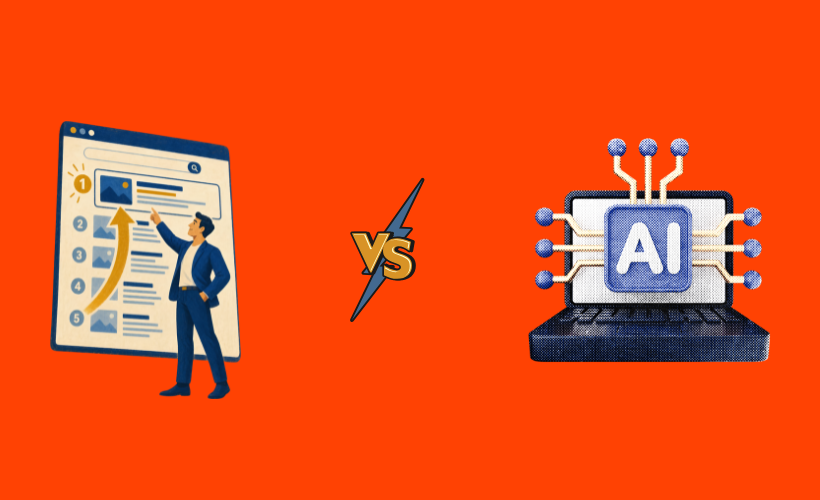
Ranking in Google and appearing in an AI-generated answer or in an AI overview are two different visibility problems.
A Google result may send someone to your page. An AI answer may summarize information from your page and cite it or choose another source instead.
That changes what SaaS companies need to measure. I have given some points here to make the connection clear.
1. Google Rankings vs AI Overviews Citation
Suppose your SaaS website ranks at position #2 for: “Best CRM for remote teams.” You might assume your brand will naturally appear when someone asks ChatGPT or Google AI:
- “What are the best CRM tools for remote teams?”
But that is not guaranteed. AI search systems can use different retrieval processes, sources, prompts, and ranking signals when producing an answer.
Google also reports AI Overviews in Search Console, so AI visibility is now measurable alongside traditional Search performance.
For example, your page ranks #2 in Google, but three competitor websites are cited in the AI Overview.
- Your SEO visibility is strong.
- But your AI citation visibility is weaker.
That difference is exactly what GEO helps you investigate. To clarify the concept more, learn from the guide below:
2. AI Search is About Answers, Not Just Rankings

Traditional search usually gives users a list of results. AI search can instead produce an answer and provide sources behind that answer.
ChatGPT Search and Perplexity both provide citations or links to supporting web sources. For a SaaS business, this creates a different opportunity.
Instead of asking only:
- What keyword should my page rank for?
You also need to ask:
- What questions should my SaaS be considered a useful answer for?
For example:
- Which CRM is best for remote teams?
- What is the best analytics tool for WooCommerce?
- Which SEO plugin is suitable for small businesses?
- What software can automate customer support?
- What are alternatives to [competitor]?
These are the types of questions where your brand may need to appear in an AI-generated answer.
You can call this keyword as Inner circle of funnels: money keyword, commercial keyword, BOFU keyword. In my opinion go at first with the prompt of inner circle first as your competitors are ahead of this or you will be the first one who can go ahead of them.
Use affordable tool Zero Rank AI for inner circle keywords to go ahead in the competition as all keywords is not useful if you lose sales with inner circle intent.
Another opinion from me that from the beginning we used to follow TOFU → MOFU → BOFU. you should change or tilt the approach BOFU → MOFU → TOFU (TOFU is not too much necessary as Google AI overview already covered it). So Focus on BOFU then MOFU.
3. Clear Information Makes Your SaaS Easier to Understand

AI systems need to understand what your business, product, and content are actually about. A vague product page might say:
- Transform your workflow with next-generation intelligent automation.
That sounds like marketing copy, but it tells an AI system very little. A clearer version might say:
“Our workflow automation software helps SaaS teams automatically assign leads, send follow-up emails, and update CRM records.”
The second version gives much stronger context. Clear > clever.
Your product pages should make important facts easy to identify rather than hiding them behind vague marketing language.
4. Your Own Website is Not the Only Source
A common GEO mistake is thinking: “If I optimize my website, AI will cite my website.” It does not always work that way. AI systems can use information from many different sources.
For example, Perplexity describes its search process as searching across articles, academic papers, forums, videos, and other sources depending on the query.
That means SaaS businesses should also pay attention to:
| GEO Activity | What It Helps With |
|---|---|
| Industry publications | Build authority and third-party visibility |
| Product reviews | Provide independent information about your software |
| Comparison websites | Help AI understand your product against alternatives |
| Partner websites | Build relevant third-party references |
| Expert articles | Demonstrate expertise around your SaaS category |
| Customer discussions | Provide real-world product experiences |
| Reddit & niche communities | Capture genuine discussions, experiences, and recommendations |
| Quora | Answer relevant questions and build topical visibility |
| Niche forums | Reach highly relevant communities around your software category |
| Software directories | Establish your product, category, features, and company information |
| Case studies | Provide evidence of real-world product use |
| Third-party recommendations | Build independent references to your SaaS |
| Backlinks | Create relevant connections between websites |
| Brand mentions | Increase references to your company across the web |
| Guest posts | Demonstrate expertise and earn relevant third-party exposure |
I am not telling you to focus on all things off-page SEO, as GEO is therefore bigger than on-page SEO. What I am telling you here is you need to be visible outside your boundaries.
Start with the most impactful 1-3, based on competitors who are doing well in this industry. If you focus on all things, you can’t get a single penny from these strategies.
For example, It’s like you have a 1-liter water bottle and 12 glasses to pour into; if you pour into all the glasses, you can’t even have a glass of it. Instead, pour 3-4 glasses and quench your thirst.
In short, you need both strong first-party information and a credible presence across the wider web from other sources.
How to Implement GEO for RAG Process
You do not need to become an AI engineer to start GEO. Your job as a SaaS marketer or founder is not to build the RAG system.
Your job is to make your information easy to find, understand, verify, and reference. Here is a practical process.
1. Start With Real Customer Questions

Do not begin with technical RAG terminology. Begin with the questions your potential customers actually ask.
For example, if you sell WooCommerce analytics software:
- What is the best analytics tool for WooCommerce?
- How can I find where WooCommerce customers drop off?
- What tools can track WooCommerce user behavior?
- What is an alternative to Google Analytics for WooCommerce?
- Which WooCommerce analytics tools are easy for beginners?
These questions become your GEO content opportunities. For these answers, I will recommend a marketing book that I read 2 years ago: “They Ask, You Answer” by Marcus Sheridan.
Read this book, and your problem is solved.
2. Create Direct Answers
Give the answer as early as possible. After the heading and subheadings, so that it will be easy for AI crawlers to understand it and implement a RAG system in your article.
For example:
WooCommerce analytics software helps store owners understand where visitors come from, how they behave on product pages, and where they leave before purchasing.
Then explain the topic in more detail. If possible, give examples and statistics, and if more possible, give a graph or chart.
This structure is useful for both human readers and machines because the main concept is clearly defined before the supporting information.
3. Make Your Product Entity Clear

Your website should consistently explain: Brand → Product → Category → Features → Use cases → Audience
For example, my website:
WhatIsGuide → GEO marketing guide → SaaS/WordPress Tools/software marketing → AI visibility, citations, content optimization → SaaS founders and marketers.
Do the same thing on your own SaaS website. Do not make an AI system guess whether your product is:
- SEO software
- Analytics software
- CRM software
- Marketing automation software
- WordPress plugin
- AI writing tool
State it clearly and spread it all over the internet because clarity is the 3rd fundamental of GEO.
4. Build Topical Authority Around Your Product

One product page is rarely enough to demonstrate your expertise around an entire topic. Suppose your SaaS product is CRM software.
Instead of publishing only: “Our CRM Software”
Build supporting content around:
- CRM for startups
- CRM for remote teams
- CRM lead management
- CRM automation
- CRM integrations
- CRM reporting
- CRM alternatives
- CRM implementation
- CRM pricing
- CRM comparison guides
This creates a clearer relationship between your brand and the problems your product solves. But make sure you don’t overlap information and topics. How can you understand it? See the intent and explain it clearly.
When you are writing for the team. Explain clearly in your content that this is for the team, and when it is for a startup, explain it clearly throughout the content to avoid overlap.
5. Use Clear Page Structures

Make important information easy to identify. A SaaS page could use:
- H1 for the main topic
- H2s for major questions
- H3s for supporting questions
- Short definitions
- Feature explanations
- Use cases
- Comparison tables
- FAQs
- Pricing information
- Internal links
- Relevant structured data
The goal is not to add headings simply because GEO recommends them. The goal is to make the information organized and unambiguous.
6. Strengthen Third-Party Visibility

Your website tells AI what you say about yourself. Third-party sources can provide additional context about your brand.
For example, if several relevant websites independently describe your software as a website analytics platform, that creates a broader web presence around the same entity.
So your GEO strategy can include:
- Digital PR
- Industry publications
- Expert contributions
- Product reviews
- Relevant directories
- Partner content
- Customer case studies
- Comparison websites
Think beyond your domain. I think I already described it I again describe to improve and give importance in this sector. Because nobody cares about you saying loudly I am the best if people and other sources don’t is not telling this.
7. Track Citations, Not Just Rankings
This is where AI visibility tools become useful. You can test prompts such as:
“What are the best CRM tools for remote SaaS teams?”
Then check:
- Did my brand appear?
- Which competitors appeared?
- Was my website cited?
- Which competitor pages were cited?
- What topics trigger competitor visibility?
- Does my visibility change over time?
This turns GEO from a vague concept into something you can monitor. Now I am going to tell you which tools is effective and affordable so that you will win with the tools.
5 GEO Tools for SaaS Businesses
You do not need five tools running at the same time. Choose a tool based on affordable price, how much AI visibility data you need, and whether it covers all platforms. So choose wisely:
1. ZeroRank AI – Best for Affordable AI Visibility & Citation Tracking
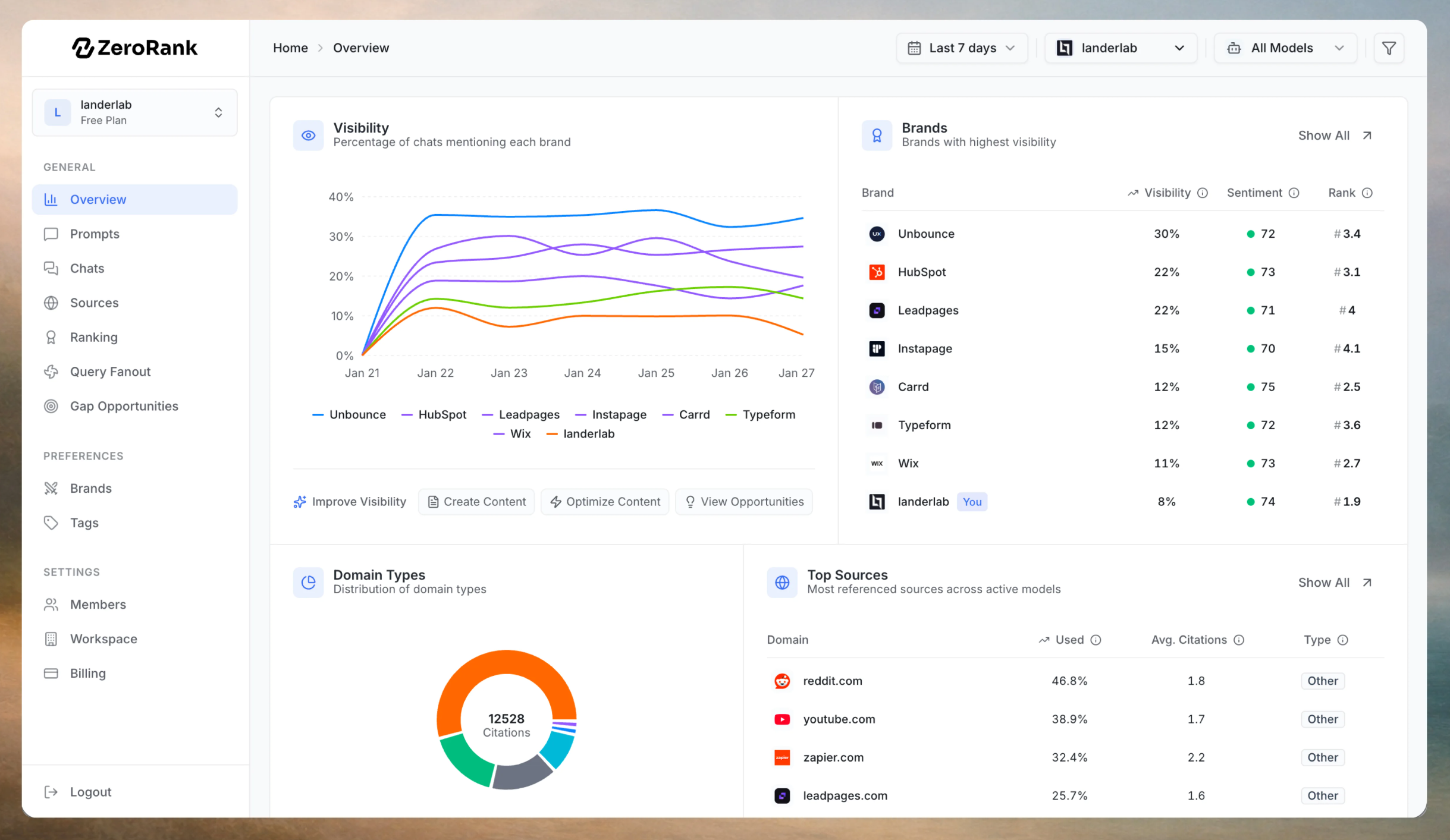
ZeroRank AI focuses specifically on AI search visibility.
It tracks brand visibility across 17 AI platforms, including ChatGPT, Perplexity, Gemini, Google AI Overviews, Google AI Mode, Claude, and others. It also provides prompt research, competitor tracking, citation analysis, and recommendations.
Useful for SaaS businesses because:
- Track where your brand appears
- Monitor AI citations
- Research important prompts
- Compare competitors
- Find visibility gaps
- Track multiple AI platforms
If your main goal is to understand “Where does my SaaS appear in AI search, and which sources are being cited?”, this type of dedicated AI visibility tracker is a practical starting point.
2. OtterlyAI – Best for AI Search Monitoring
OtterlyAI tracks brand mentions, citations, sentiment, and share of voice across AI search engines.
Its current platform covers ChatGPT, Google AI Overviews, Google AI Mode, Gemini, Perplexity, Microsoft Copilot, and Claude.
It can be useful when you want to monitor specific customer prompts and see how your brand and competitors appear in the resulting answers.
3. Semrush AI Visibility Toolkit – Best for SEO + AI Visibility
If your team already uses Semrush for traditional SEO, its AI Visibility Toolkit connects AI visibility with existing SEO workflows.
It can track brand visibility across AI platforms, compare competitors, analyze citations, research prompts, and identify content or technical gaps.
This makes sense for teams that do not want their traditional SEO and GEO data in completely separate workflows.
4. Scrunch – Best for Citation Analysis
Scrunch focuses heavily on AI search visibility and citation data. Its citation reporting shows which sources AI systems reference, including brand, competitor, and third-party sources.
That can help answer an important GEO question: “Why is my competitor being cited while my website is not?”
Instead of only tracking whether your brand appears, you can investigate the sources being used around your category.
5. Peec AI – Best for AI Search Insights
Peec AI can be considered when your goal is to monitor how your brand appears across AI search and identify opportunities for improving visibility.
For SaaS teams, the useful workflow is similar: Track prompts → monitor mentions → inspect competitors → identify gaps → improve content → track again.
The important part is not simply choosing a tool. The important part is creating a repeatable measurement process.
In my opinion, start with an affordable option, as you are new here, so that you will be on track but not overwhelming of it’s functionality.
- Learn more – Best 5 Affordable AI Citation Tracking Tools for GEO
RAG + GEO: The Simple SaaS Strategy
You can think about the whole process like this:
Customer question → AI search retrieves relevant information → Your content is considered alongside competing sources → AI generates an answer → Some sources may receive citations → User discovers your SaaS product
Your GEO is to improve the chances that your business has useful, clear, relevant, and credible information available at the points where AI systems search for answers.
That does not mean there is a guaranteed formula for getting cited. AI search systems can change how they retrieve and present information, and even cited results can be incomplete or incorrect.
OpenAI itself recommends checking cited sources rather than assuming every AI search result is accurate.
Conclusion
RAG may sound like a technical AI term, but SaaS marketers do not need to build a RAG system to understand its importance. The simple idea is: AI needs information before it can use that information to answer a question.
GEO helps you make your SaaS information easier to understand, discover, and reference. So instead of focusing only on: “How do I rank #1 on Google?”
Add another question: “When my potential customers ask AI about the problem I solve, is my brand and useful information available to be discovered and cited?”
Your Google rankings still matter. But if customers are also using AI search to research software, your visibility strategy needs to look beyond the traditional search results page.
To make the whole process easier, you should use an affordable tool like Zero Rank AI to track your citations, mentions, share of voice, competitors’ AI visibility, etc.
** FAQs **
1. Why does my SaaS rank on Google but not appear in Google AI Overviews?
A high Google ranking does not guarantee inclusion in an AI Overview. AI Overviews can get information from multiple sources, and the sources shown can differ from the traditional blue-link results. So make your content optimized for GEO, but human-friendly is the solution.
2. Why is my competitor cited by AI when my website ranks higher?
Ranking position and citation selection are not the same measurement. The AI system may find your competitor’s page more directly relevant to the question, or it may retrieve information from another source that better answers a specific part of the query.
Check the actual cited pages rather than assuming your Google position should determine the AI result.
3. Do I need to understand embeddings and vector databases for GEO?
No. Those concepts help explain how some retrieval systems work technically, but a SaaS marketer can focus on the practical side: Create clear information → cover relevant questions → build topical authority → strengthen third-party presence → monitor AI visibility.
4. Is GEO just SEO for ChatGPT?
No. SEO and GEO overlap, but they are not identical. SEO focuses heavily on visibility in traditional search results. GEO focuses on visibility within AI-generated answers, including mentions and citations. The two strategies should work together rather than replacing one another
5. Why does ChatGPT mention my brand but not cite my website?
A brand mention and a website citation are different things. An AI answer can mention your company while citing another website as its supporting source. That is why GEO tracking should measure both brand mentions and citations, rather than treating them as the same metric.
6. How do I find out why AI is not mentioning my SaaS?
Start with the questions your potential customers are asking. Run those prompts through the AI platforms you care about and record:
– Which brands appear
– Which pages are cited
– Which competitors appear
– What information the cited pages provide
– Which topics repeatedly trigger competitor visibility
Then compare those findings with your own content. Tools such as ZeroRank AI, OtterlyAI, Semrush, and Scrunch can make this monitoring process easier.